In a sustainable building project, people think about insulation, materials, energy. Signage often comes later. Yet dozens of signs made, transported and replaced weigh on the footprint. Here are the levers that really count.
Why signage matters
A public building, a hotel or a tourist site often has several dozen signs. If they are plastic, printed and replaced every three or four years, their impact is not negligible. Eco-designing signage means thinking about every stage of its life: material, manufacture, transport, use, end of life.
Lever 1: the material
Wood is a renewable resource. A tree stores carbon as it grows, and that carbon stays in the wood as long as it is not burned or decomposed. Plastics, on the other hand, are made from oil.
The forest still has to be sustainably managed. That is what the labels PEFC and FSC guarantee: they certify that the wood comes from forests where no more is harvested than grows back. If a supplier highlights a label, ask for the certificate number: it can be checked online.
Most of our wood comes from sustainably managed French forests. Local sourcing also reduces the transport of raw materials.
Lever 2: the right thickness
People often oversize as a precaution. An indoor sign does not need 19 mm: 3 mm plywood or 5 mm solid wood is enough and uses four to six times less material. Keep thick materials for outdoors, where they stop the sign from warping: 18 mm marine-varnished okoume CTBX for a sign in the rain, 19 mm 3-ply spruce for a sheltered shop sign that must be seen from afar.
Lever 3: manufacture
Laser engraving marks the wood by burning its surface. It needs no ink, paint, solvent or printed adhesive film. CNC cutting follows a digital file and nests the pieces as tightly as possible on the board, which reduces waste.
Lever 4: lifespan
The most sustainable sign is the one you do not have to remake. Three rules extend its life:
- The right wood in the right place : a thin sign fitted outdoors deteriorates quickly.
- Text that does not date : avoid opening hours, prices or people’s names on a permanent sign.
- Separate signs rather than one big board: when a piece of information changes, you replace one sign, not the whole set.
The engraving itself does not wear off: there is no ink to redo.
Lever 5: end of life
An engraved wooden sign contains no plastic, apart from the fixing adhesive. It is processed with wood waste. A printed PVC or aluminium composite sign is much harder to recycle.
Planning the whole series
The last lever is organisation. Ordering all the signage at once, with a common style guide, avoids reprints, multiple shipments and mismatched signs that end up being replaced. List your needs room by room, choose one wood and two sizes, and have the whole series engraved in one go.
In short
- Wood from sustainably managed forests, checking the labels claimed.
- The thickness suited to the use: 3 to 5 mm indoors, 18 mm okoume outdoors.
- Engraving without ink.
- Durable texts and separate signs.
- A series planned in a single order.
A complete project, with your logo and your texts? Ask for a quotation : proof and price within 48 h.
Matching signs
-
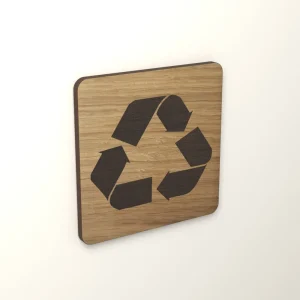
Wooden Waste Sorting sign
Price range: 14,90 € through 34,90 € Select options This product has multiple variants. The options may be chosen on the product page -
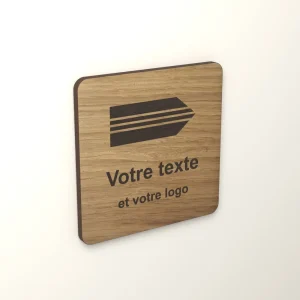
Customisable square wooden plaque
Price range: 14,90 € through 34,90 € Select options This product has multiple variants. The options may be chosen on the product page -
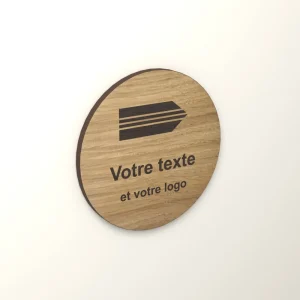
Customisable round wooden plaque
Price range: 14,90 € through 34,90 € Select options This product has multiple variants. The options may be chosen on the product page -
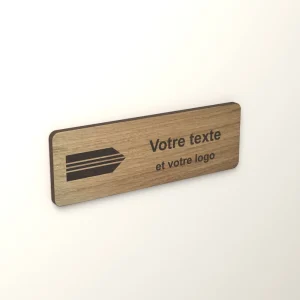
Customisable rectangular wooden plaque
Price range: 14,90 € through 54,90 € Select options This product has multiple variants. The options may be chosen on the product page